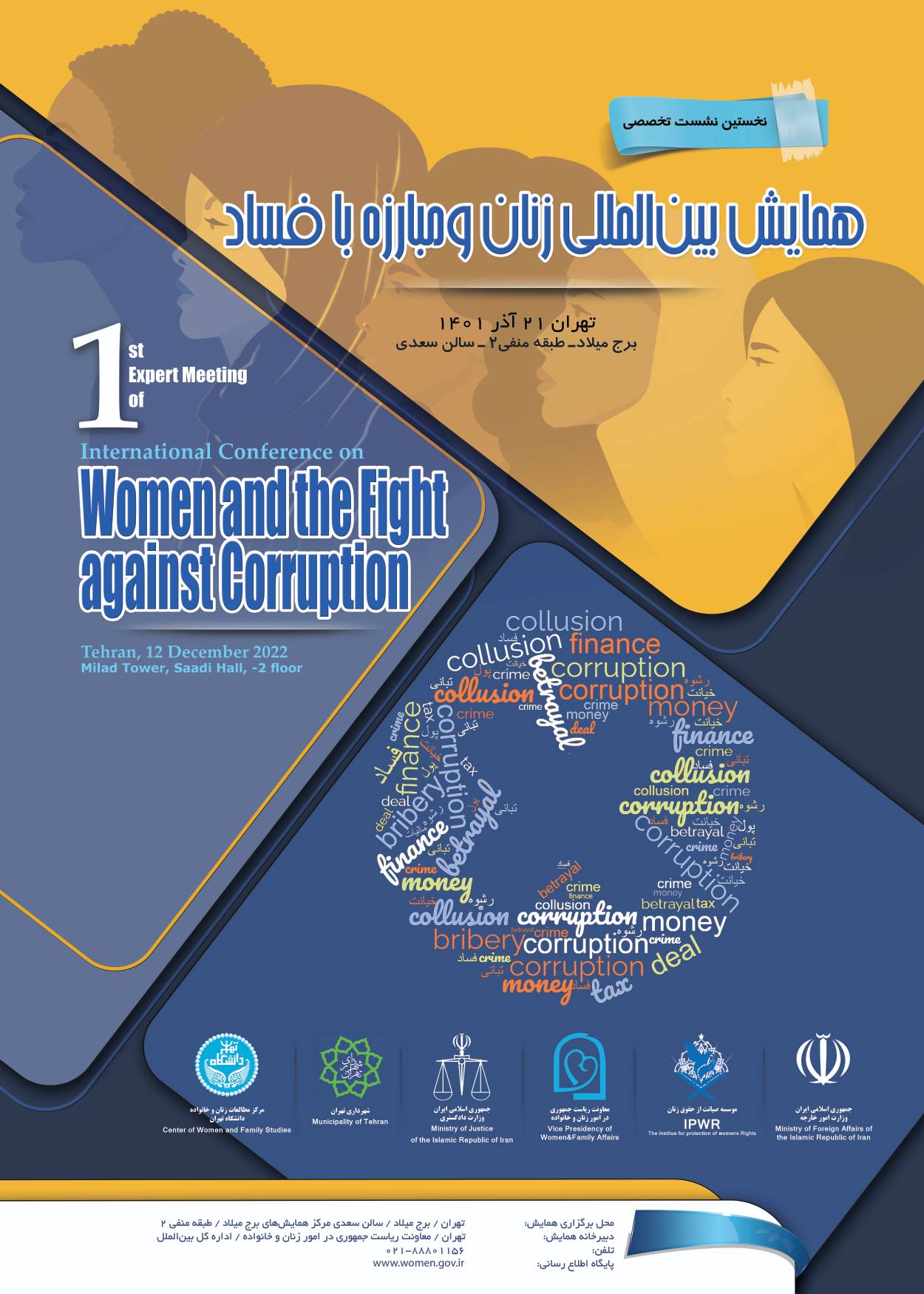
The first specialized meeting of the international conference on “Women and Fighting Corruption” was held at Milad tower, Tehran initiated by the vice-presidency for women and family affairs and in collaboration with the Ministry of Foreign Affairs, Ministry of Justice, Institute for Protection of Women’s Rights, Women and Family Studies department of Tehran University and Tehran Municipality.
The vice -presidency for women and family affairs hosted representatives from over 30 embassies namely, Swiss, Tunisia, Venezuela, Australia, Cuba, Chile, Bangladesh, Japan, Bolivia, Brazil, Italy, Kirgizia, Nigeria, Mexico, Nicaragua, Zimbabwe, Vatican, Syria, Palestine, Slovenia, Oman, Guyana, Pakistan, Argentina, the Philippines, South Africa, and many scientific, cultural, political and social figures from governmental and non- governmental institutions, researchers and scholars .
A working group entitled, “Women and Fighting Corruption” is part of the agenda of the vice-presidency for women and family affairs
At the meeting Dr. Ensieh Khazali, vice-president for women and family affairs said: “Some of the studies have shown that due to women’s peace- making spirit no matter what position they may hold in that administration and system would encounter less corruption. In many communities due to the type of role they play in family and in a wider range of society, women observe more cooperation, ethics, and public interests more than men.
The economic and administrative corruption distorts public trust and the rule of law, it weakens human rights and defects peace making and prevents gender justice and efforts to achieve them, hence, the world cannot let corruption to continue. At the same time the results gained throughout the years for fighting corruption at national and international levels show that corruption affects men and women in very different ways and therefore, it is highly paramount and inevitable.
In fact, the unfair gender discrimination that has encountered women throughout history and continues to this day leads to even greater vulnerability of women. For instance , gender based inequality , in particular, in terms of education, would weaken the voices of women, make them more prone to administrative corruption, since these groups of women are less aware of their rights, they are less capable of discussing their problems and fail to report infringement or in many countries women compose a large part of the manpower in the informal sector which has less supervision and the employers allocate less wages for the women employees which in itself is a corruption . Moreover, in areas such as property rights and sexual violence due to many reasons such as fear of retaliation or that they are overlooked or their reports are underrated fewer women refer to courts and submit their complaints.
The vice-president added:
“As the national focal point of the policymaking institution in women and family affairs areas the vice -presidency has proposed the establishment of a working group on women and fighting corruption that would bring positive effects in supporting women and increasing their participation in fighting corruption.
Part of the tasks of this working group is determining the priorities of fighting administrative, economic and gender- based corruption with regards to the role and status of women and to provide the grounds for enforcing the Sharia laws and the laws pertaining to women , to institutionalize meritocratic system, benefitting from qualified and efficient women who fight corruption in various areas and at different layers of management ,policy makings and administration levels, offering legal, executive and judicial solutions in order to support victimized women resulting from administrative , economic and sexual crimes , collaboration with various organizations and offering judicial assistance and counselling for victimized women affected by corruption.
The international communities are responsible to benefit from the special and unique abilities of women in fighting corruption at various levels, thus, depriving women from taking part in the international communities due to the US attempt to remove Iran from the Commission on the status of Women in particular, is a blatant aggression against women in Iran trampling on their inalienable rights.
Moreover, those claiming to eliminate discrimination are broadly perpetuating discrimination against some women merely with political approaches and through media hype without any form of scientific background.
This uncommon act will have very negative consequences in these communities hence, it is the duty of all countries to stand against these bullying attempts and approaches that would penetrate corruption into the international organizations.”
The proposal to remove Iran from the Commission on the Status of Women is a blatant abuse of power
Dr. Khadijeh Karimi, director general of international affairs department of vice-presidency for women and family affairs and secretary of the meeting while referring to the importance of the topic and the activities undertaken in this field at both national and international areas stated: “The idea of women and fighting corruption led to the establishment of an internal specialized committee entitled, “Women and Fighting Corruption”. After technical reviews in cooperation with the ministry of justice, the national focal point of the UN Convention for fighting corruption and the ministry of foreign affairs, extensive research was conducted in various areas such as psychology, sociology, law, management and women’s studies in cooperation with domestic and international researchers. In addition, a document was outlined for establishing the working group of women and fighting corruption for reviewing and approval at the National Headquarter for Women and Family affairs with the aim of focalizing and increasing the power for pursuing this issue. At international level, the idea of women and fighting corruption were discussed at the side meetings of the 66th session of the UN Commission on the Status of Women in New York with other countries and the idea was welcomed. In addition, the topic was also recommended at the IORA women’s economic empowerment working group as one of the key chapters that was proposed by the general office as the chair of the working group and was unanimously approved by the members.”
She continued: “As it is clear from the international document corruption means abuse of power with the intention of attaining personal, group and community interests. Unfortunately, today we are witnessing the exploitation of power by some superpowers, the recent example of which was the US proposal to remove Iran’s membership from the CSW which means depriving the Iranian women from collaboration and synergy at international arena. This act is in fact an exploitation of the rights of women and to utilizing an international institution for suppressing Iran and to violating the human rights of Iranian women. “