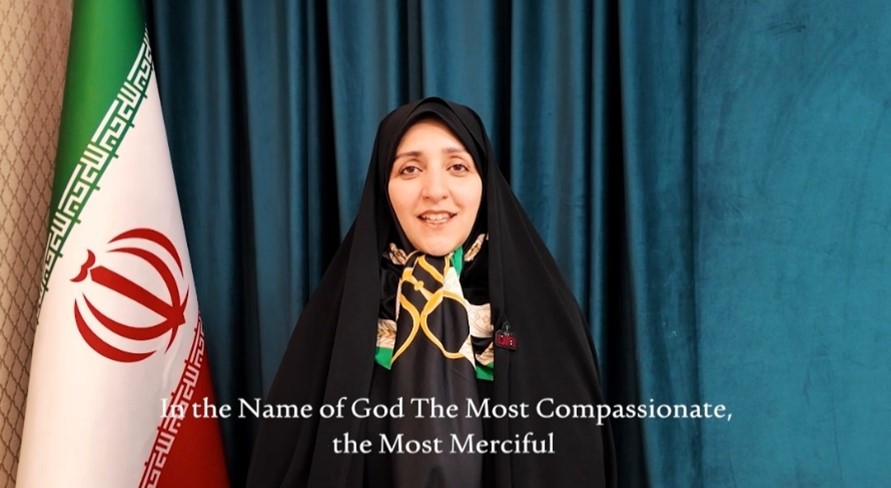
The BRICS Women Ministers' Summit began on Tuesday, July 6, in India, and Dr. Behrouz Azar, Vice President for Women and Family Affairs, delivered a speech via Pre-Recorded Video. While expressing gratitude to the Member States for expressing their condolences with the Iranian people in mourning the martyred Supreme Leader and his family, she emphasized that this profound grief has brought a fundamental truth to light: peace, security, and human dignity are not merely moral ideals, but the most important preconditions for sustainable development and the flourishing of nations.
Referring to the transformation in the concept of national power in the contemporary era, she stated that in the 20th century, nations' power was measured in barrels of oil and tons of steel. Still, the 21st century measures it by the talents that are flourishing, the greatest untapped reserve, which is not underground but lies in people's capacity, and half of that capacity is in women.
She also stressed that the key question today is how to unlock women's potential, and the answer to this question is "justice in opportunities". She affirmed that justice is the way to the flourishing of talent, and that the flourishing of women makes justice a real and lived experience in people's lives. She called this approach a legal and national commitment for Iran and added that the Constitution of the Islamic Republic of Iran puts both men and women on an equal footing under the law, recognizes education as the right of all, and obliges the government to support women's rights and pave the way for the development of their personalities and flourishing their talents.
As a result of this approach, girls' education became a national priority, literacy among women aged 10 to 49 reached about 97%, university doors opened, and girls occupied over 56% of seats in Iran's universities, and a knowledge-based economy started to grow. Women made up one-quarter of managers in knowledge-based companies. Mrs. Behrouz Azar reiterated that these are not just statistics; rather, they are the narratives of girls' lives who have found the opportunity to learn, women launching small businesses, mothers who pulled their families out of crisis, and a society strengthened as its women thrive.
While stressing that women are not just recipients of development but its architects, Dr. Behrouz Azar emphasized that talent does not flourish in isolation, and family is the first place where a girl's potential is seen and nurtured; therefore, in Iran, women's empowerment and family strengthening are pursued together. In Iran, the empowerment of women and the strengthening of the family are pursued simultaneously, and by supporting working mothers, promoting flexible work models, and establishing effective care systems, we aim to pave the way for their participation and fulfillment.
Furthermore, she presented two main proposals from Iran. The first is the "BRICS Women's Entrepreneurship and Microfinance Network": a network to connect women entrepreneurs, knowledge-based companies, microfinance funds, markets, and investors. It will offer training, mentoring, coaching, and equal access to technology and artificial intelligence. The second, the "BRICS Dialogue on Family and Social Resilience": a platform to share experiences on balancing family responsibilities and women's economic participation, as well as women's roles in caregiving, climate resilience, food security, and local development.
Finally, the Vice President said that BRICS can be more than an economic coalition; it can be a bridge among civilizations, experiences, and futures. She also noted that civilizations last not through what they build, but through the people they nurture, so we should act at a bridge, not a wall, a bridge between justice and development, family and society, technology and humanity, and between today and a future worthy of the daughters and women of our nations.