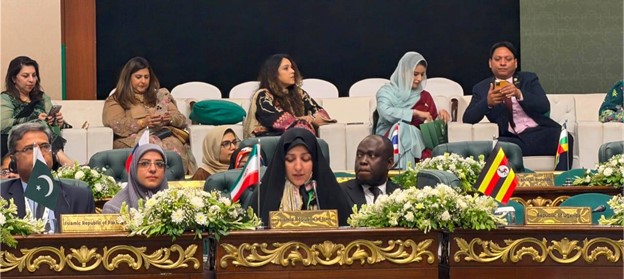
Mrs. Behrouz Azar, the Vice President for Women and Family Affairs of IRI, participated in the 9th Session of the Islamic Cooperation Organization for Women, held on July 12–13, 2026, in Islamabad, Pakistan, and delivered a speech. She expressed gratitude to Pakistan for hosting the event, to Egypt for chairing the previous term, and to Islamic countries for supporting Iran and extending condolences regarding recent military aggression against Iran.
In her speech, she highlighted Iranian women's achievements in science, society, and crisis management. She proposed creating a "Network of Women Relief Workers of the Islamic World" and a "Common Mark for Products Manufactured by Muslim Women" to enhance cooperation.
She also referred to the US-Israeli military attacks against Iran, characterizing these actions as inconsistent with principles of dialogue and diplomacy. She outlined the resulting human losses and material damages. Additionally, she acknowledged the mediating efforts of the Islamic Republic of Pakistan and the government of Qatar in reestablishing conditions conducive to understanding and dialogue. Mrs. Behrouz Azar affirmed Iran's continued commitment to dialogue and respectful conflict resolution, while emphasizing the proven resilience and steadfastness of the Iranian people in the face of aggression.
The Vice President for Women and Family Affairs highlighted the significant contributions of Iranian women across various sectors: Currently, Iranian women constitute more than 56% of university entrants, nearly 46% of doctoral graduates, and over 68% of specialists in basic sciences. They also hold a substantial proportion of managerial positions in knowledge-based companies, as well as faculty positions and inventor roles in Iran.
She presented two suggestions for the Islamic world based on Iran's experience in managing natural disasters and war. First, she emphasized that women and children are especially vulnerable during crises, yet their needs are often overlooked. She highlighted that the contribution of women in the Iranian Red Crescent Society has shown that the 'women for women' approach can play an important role in supporting affected people. Based on this, Iran's first proposal is to establish a "Network of Women Relief Workers of the Islamic World" to connect the capacities of female physicians, nurses, psychologists, social workers, and relief workers from Islamic countries, to provide more effective support for women and children in crises and strengthen preparedness and cooperation among Member States.
The second initiative, the "Common Mark for Products Manufactured by Muslim Women," was proposed to facilitate women's access to markets within Islamic countries, enhance consumer trust, promote the development of digital markets and joint exhibitions, and strengthen export training and branding.
She emphasized that Iran's proposals are rooted in the shared values of the Islamic world, such as human dignity, justice, cooperation, family, and social responsibility. These initiatives are intended to foster greater synergy among Islamic countries in supporting women during crises and promoting economic empowerment. She further asserted that building the future of the Islamic world requires utilizing existing capacities and fostering cooperation, rather than waiting for ideal conditions.